
← Back to Blogs
January 3, 2022 · 6 min read
DevSecOps
Building a Culture of Security in DevOps Teams
If you’ve spent more than five minutes in a modern DevOps team, you’ve probably heard some version of this: “We’ll fix security later.” “It’s just a small change.” “Security is slowing us d…
By Joseph Mitch, CTO of KeY2Moon Solutions
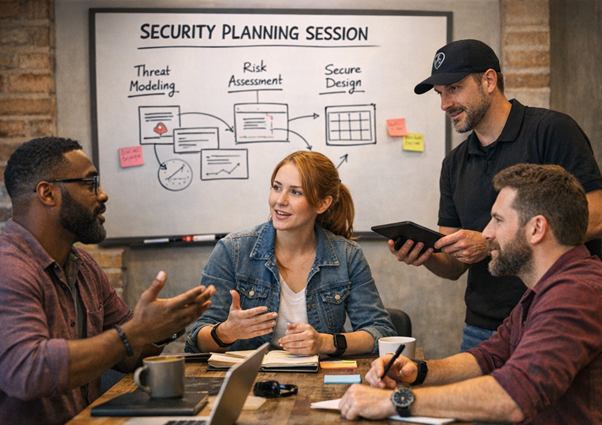
KeY2Moon Solutions shares practical insights on Building a Culture of Security in DevOps Teams to help technology leaders improve delivery speed, software quality, and long-term business resilience.
If you’ve spent more than five minutes in a modern DevOps team, you’ve probably heard some version of this: “We’ll fix security later.” “It’s just a small change.” “Security is slowing us down.” Yeah… about that. In 2026, with AI-generated code, lightning-fast CI/CD pipelines, and cloud-native everything, “later” is basically code for “after the breach.” And nobody wants to be the team that ships a feature on Friday and ends up in a postmortem (or worse, the news) on Monday. So let’s talk about something that actually matters: building a culture of security in DevOps teams - not as a checkbox, not as a last-minute audit, but as a real, lived mindset.
Security Isn’t a Department. It’s a Habit. In traditional orgs, security used to sit in its own silo. Dev builds stuff. Ops runs stuff. Security blocks stuff. Everyone complains. DevOps was supposed to break silos. But if security still feels like “those people who show up before release and say no,” you’re not doing DevSecOps - you’re doing DevOops.
A security-first culture starts with this mindset shift
If developers think security is just about compliance docs and boring checklists, they’ll mentally check out. But if they see it as part of writing clean, professional-grade software? Game on.
• Security is not someone else’s job.
• It’s not a ticket at the end of the sprint.
• It’s part of how we design, code, review, deploy, and monitor.
Training That Doesn’t Feel Like Punishment
Let’s be honest: most security training is painful. Slides. Policies. “Don’t click phishing links.” Everyone zones out. If you want DevOps teams to care, training needs to feel relevant and practical - not like corporate babysitting.
Here’s what actually works
🔥 Hands-on, Code-Level Training
When developers see how a tiny oversight can escalate into a full-blown breach, it clicks. 🧠 Microlearning > Marathon Sessions
• Show real examples of vulnerable code.
• Run live exploit demos (nothing wakes people up like seeing an injection attack in action).
• Use secure coding labs tied to your tech stack (Node, Go, Python, Kubernetes - whatever you actually use).
Instead of one giant yearly training, bake security learning into the workflow
Make it lightweight, consistent, and tied to real incidents. Nobody wants a 3-hour lecture. But a 15-minute deep dive? That’s manageable.
• Short monthly sessions.
• Slack security tips.
• Quick “vuln of the week” breakdowns.
Shift Left - But Don’t Just Say It
Catch security issues as early as possible.
• “Shift left” is one of those buzzwords that sounds cool in conference talks. But in reality? It means this:
In DevOps, that means security is part of
• Pull request reviews
• CI pipelines
• Infrastructure as Code
• Container builds
Automate the Boring Stuff
Use automated scanning tools in your pipeline
When a developer pushes code and the pipeline says, “Hey, this library has a critical CVE,” that’s instant feedback. No drama. No blame. Just improvement. The key is to avoid weaponizing the tools. If every build fails for minor stuff, people will just mute alerts. Tune your thresholds. Make signals meaningful.
• Static Application Security Testing (SAST)
• Dependency scanning
• Container image scanning
• Infrastructure misconfiguration checks
Security + Dev = Partners, Not Rivals
Here’s where culture really gets built (or destroyed). If security teams are seen as the “Department of No,” collaboration dies fast. Instead, embed security into the team. 💡 Appoint Security Champions
Pick engineers inside DevOps squads who
They’re not auditors. They’re peers. That changes everything. 🤝 Involve Security in Planning Don’t wait until the feature is done to ask, “Is this secure?”
• Care about security
• Get deeper training
• Act as the go-to person for secure design questions
Bring security into
When security is part of the design phase, it stops being a blocker and starts being a design partner.
• Architecture discussions
• Threat modeling sessions
• Design reviews
Make Security Visible in Daily Work
If security only comes up during audits or incidents, it feels abstract. Instead, weave it into everyday workflows.
Include Security in Definition of Done
Make it standard. No special drama. Just how things are done.
• A feature isn’t “done” unless:
• Dependencies are scanned
• Secrets aren’t hardcoded
• Access controls are validated
• Logs and monitoring are in place
Track Security Metrics Like You Track Performance
Teams obsess over
• Deployment frequency
• Lead time
• Error rates
Why not also track
What gets measured gets improved. Simple as that.
• Time to remediate vulnerabilities
• Number of critical issues per release
• Percentage of services with proper monitoring
Blameless Postmortems (Yes, Even for Security)
Stuff will go wrong. That’s life in tech. But if every security issue turns into a blame game, people will hide mistakes. And hidden mistakes are how breaches snowball.
Instead
A culture of safety - psychologically and technically - makes teams more transparent. And transparency is security’s best friend.
• Run blameless postmortems.
• Focus on system failures, not individual ones.
• Ask: “What allowed this to happen?” not “Who screwed up?”
AI, Automation, and the 2026 Reality
Let’s address the elephant in the room: AI-assisted development. Developers are generating code with copilots. Infrastructure templates are auto-created. Pipelines spin up in seconds. That’s amazing… and terrifying.
AI can
• Suggest insecure code
• Pull outdated libraries
• Reinforce bad patterns
So security culture now includes
We’re moving faster than ever. Which means security can’t be manual and reactive anymore. It has to be automated and intentional.
• Reviewing AI-generated code critically
• Treating automation outputs as drafts, not gospel
• Adding guardrails in pipelines for generated artifacts
The Real Secret: Leadership Sets the Tone
You can have all the tools in the world. If leadership only celebrates speed and ignores security, guess what teams will optimize for? Velocity.
But if leaders
Then security becomes part of engineering excellence - not a tax.
• Praise secure design decisions
• Allocate time for refactoring
• Invest in security tooling
• Treat incidents as learning opportunities
Final Thoughts: Security Is Culture, Not Compliance
Building a culture of security in DevOps isn’t about fear. It’s not about slowing people down. And it’s definitely not about endless documentation.
It’s about this
When teams genuinely care about protecting user data and system integrity, security stops being a “task” and becomes part of their identity. And honestly? That’s when you know you’ve leveled up. Because in a world shipping code 24/7, the real flex isn’t just moving fast. It’s moving fast - and not breaking trust along the way.
• Making secure choices the default.
• Empowering developers with knowledge and tools.
• Treating security as craftsmanship, not bureaucracy.
How this applies to your IT roadmap
For technology leaders, success comes from turning strategy into repeatable execution. KeY2Moon Solutions helps product and engineering teams convert architecture, security, and delivery goals into reliable implementation plans.
• Technology consulting aligned to product and business priorities
• Custom software engineering for scalable digital platforms
• Cloud, DevSecOps, and modernization support for enterprise teams
“Build for resilience, deliver with confidence, and scale with KeY2Moon Solutions.”
If your organization is planning initiatives in devsecops, software modernization, DevSecOps, cloud architecture, or custom product engineering, KeY2Moon Solutions can help define the right next steps.
DevSecOps
IT Consulting
DevOps
Cloud Strategy
Need help applying this to your product?
Reach out and we can map these concepts to your roadmap, team structure, and platform constraints.